- AMD Ryzen AI Halo enables powerful AI development to run locally without cloud dependency
- 128GB unified memory is a game-changer for running large language models locally
- Local AI development offers better privacy, lower latency, and cost efficiency
- This technology empowers developers to build AI-powered applications more accessible
Artificial intelligence is moving closer to where software is built.
For years, AI development has depended heavily on cloud infrastructure, remote GPUs, and external APIs. That model isn't disappearing—but a new opportunity is emerging alongside it: powerful AI development running locally.
AMD's Ryzen AI Halo is a compelling example of that shift.
For BravionTech, a company focused on building modern digital solutions, this development is particularly interesting because it brings together three things developers increasingly need: compute, memory, and local AI capability.
Why Ryzen AI Halo Caught Our Attention
At BravionTech, we believe technology platforms matter most when they enable developers to solve real business problems.
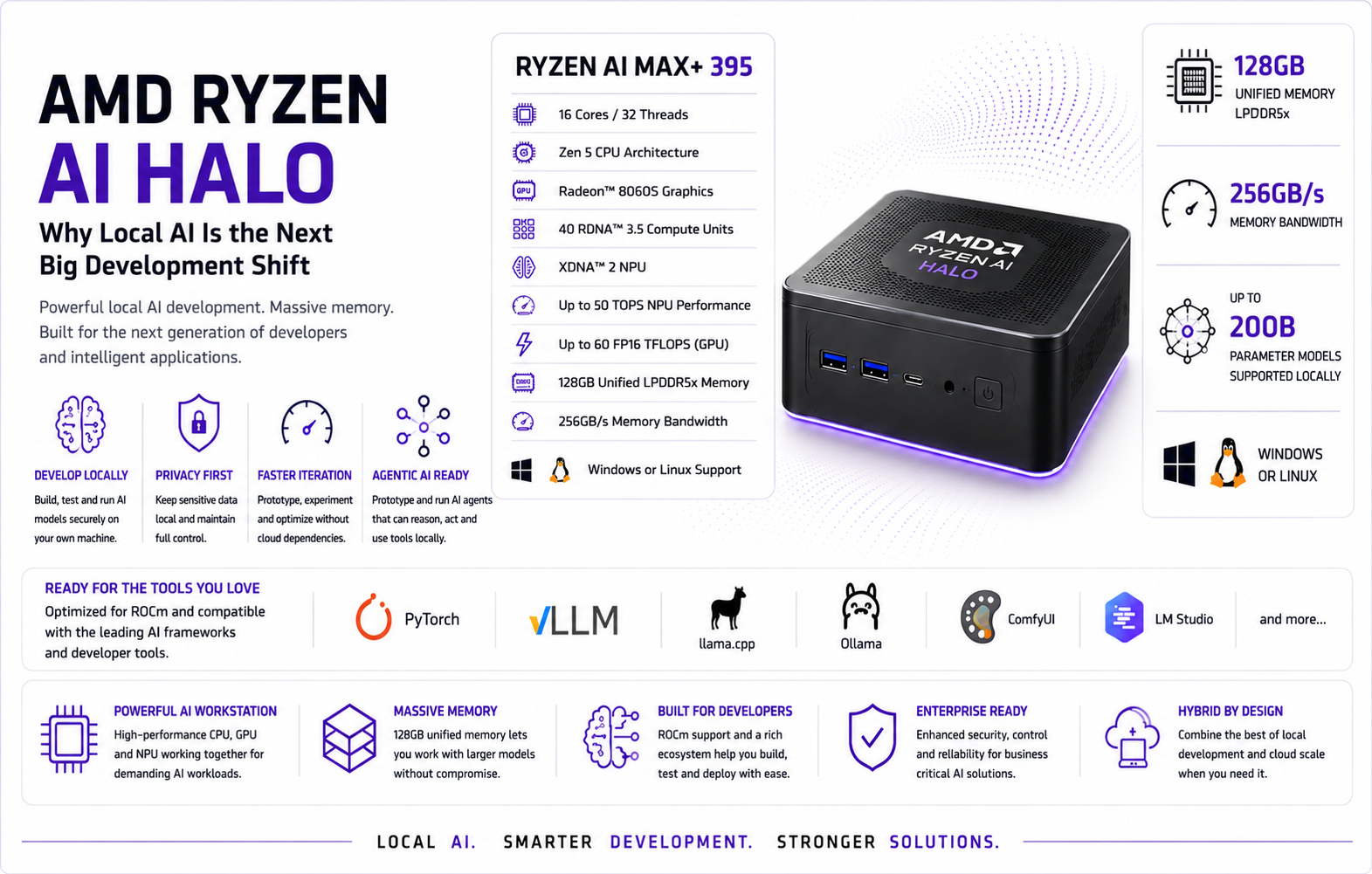
Ryzen AI Halo is designed as a compact AI developer platform built around AMD's Ryzen AI Max+ 395 processor.
Its headline capabilities include:
- 16 CPU cores and 32 threads
- Zen 5 CPU architecture
- Radeon 8060S graphics
- 40 RDNA 3.5 compute units
- XDNA 2 NPU
- Up to 50 TOPS of NPU performance
- Up to 60 FP16 TFLOPS of GPU performance
- 128GB of unified memory
- 256GB/s memory bandwidth
The combination is what makes the platform interesting for AI developers.
It isn't simply about having a fast processor. It's about having a system designed around modern AI workloads.
128GB Unified Memory Changes the Conversation
One of the most important characteristics of AI hardware is memory.
Large AI models can quickly exceed the practical memory limits of conventional developer machines.
Ryzen AI Halo offers 128GB of unified LPDDR5x memory, allowing CPU and GPU resources to work from the same memory pool.
AMD says the platform can support AI models with up to 200 billion parameters locally, depending on the model and configuration.
For developers, that opens interesting possibilities. Instead of constantly moving between a local development environment and cloud infrastructure, teams can experiment with substantially larger AI workloads on their own machines.
What This Could Mean for BravionTech
For a technology company like BravionTech, local AI isn't about replacing cloud computing. It's about adding another layer to the development stack.
We see potential in areas such as:
AI-Powered Applications
Developers can experiment with local inference while building applications that use generative AI, computer vision, recommendation systems, and intelligent automation.
AI Agents
The rise of agentic AI requires systems that can reason, use tools, interact with applications, and complete multi-step tasks. A powerful local development platform can make experimentation with these workflows more accessible.
Privacy-Sensitive Solutions
Some applications work with sensitive business information. Local model development and inference can provide another option for teams that need greater control over where data is processed.
Faster Prototyping
Developers can test models, prompts, workflows, and AI integrations without depending on a remote environment for every iteration. More experimentation can lead to better products.
Local AI Doesn't Mean Cloud AI Is Dead
This distinction is important.
Cloud infrastructure remains essential for large-scale training, production workloads, distributed applications, and organizations requiring enormous compute capacity.
The future is more likely to be hybrid.
Think: Local development + Edge inference + Cloud scale. Developers can choose the right environment based on the workload. That's a much more flexible architecture.
The Software Ecosystem Matters
Hardware specifications only tell half the story. The developer experience determines whether a platform becomes genuinely useful.
AMD is building Ryzen AI Halo around its ROCm software ecosystem and support for popular AI development tools and frameworks. That includes technologies such as:
- PyTorch
- vLLM
- llama.cpp
- Ollama
- ComfyUI
- LM Studio
For development teams, compatibility with familiar tools can significantly reduce the barrier to experimentation.
A Platform for the Next Generation of Developers
The most interesting part of Ryzen AI Halo isn't necessarily what it can do today. It's what developers can build with it tomorrow.
Imagine a developer workstation capable of locally experimenting with:
- AI coding assistants
- Private enterprise chatbots
- Autonomous AI agents
- Local RAG systems
- Image generation
- Intelligent automation
- AI-powered developer tools
That changes the role of the workstation. It becomes an AI laboratory.
Why This Matters for Businesses
AI adoption isn't just a technology decision anymore. It's a business decision.
Organizations want AI solutions that are:
- Fast
- Secure
- Cost-effective
- Scalable
- Maintainable
Local AI hardware can become another tool for achieving those objectives. For companies like BravionTech, this creates opportunities to evaluate new architectures and develop solutions that balance performance, privacy, cost, and scalability.
What We Will Be Watching
At BravionTech, several areas around Ryzen AI Halo are particularly interesting:
Developer productivity: Can local AI reduce development and testing cycles?
Agentic AI: How effectively can developers run increasingly capable AI agents locally?
Enterprise AI: Can local inference provide practical advantages for privacy-sensitive workloads?
Hybrid architectures: How can local AI and cloud infrastructure work together?
Software optimization: How quickly will AI frameworks and tools continue improving for AMD hardware?
These questions are ultimately more important than benchmark numbers alone.
The Bigger Industry Shift
The AI industry has spent years building bigger data centers. Now another trend is emerging.
Bring more intelligence to the device.
AI PCs, edge AI systems, local inference platforms, and developer-focused AI hardware are all moving in that direction. AMD Ryzen AI Halo fits directly into this broader transition. And for developers, that could be significant.
Key Takeaways
- AMD Ryzen AI Halo is designed for demanding local AI development.
- Its 128GB unified memory is particularly interesting for larger AI models.
- AMD positions the platform for agentic AI and local AI workloads.
- ROCm and popular AI tools are important parts of the developer experience.
- Local AI complements rather than completely replaces cloud infrastructure.
- Hybrid AI architectures could become increasingly common.
- Developers now have more opportunities to experiment with powerful AI workloads locally.
BravionTech's Perspective
At BravionTech, we see technology through the lens of what it enables businesses and developers to build next.
Ryzen AI Halo represents an interesting step toward a world where powerful AI development isn't confined to large cloud environments. The workstation itself is becoming intelligent.
And as AI moves from chatbots toward agents, automation, and autonomous software, having powerful local development infrastructure could become increasingly valuable. The future won't necessarily be cloud versus local. It will be about knowing when to use both. And we're excited to see what developers build with the new generation of AI hardware.