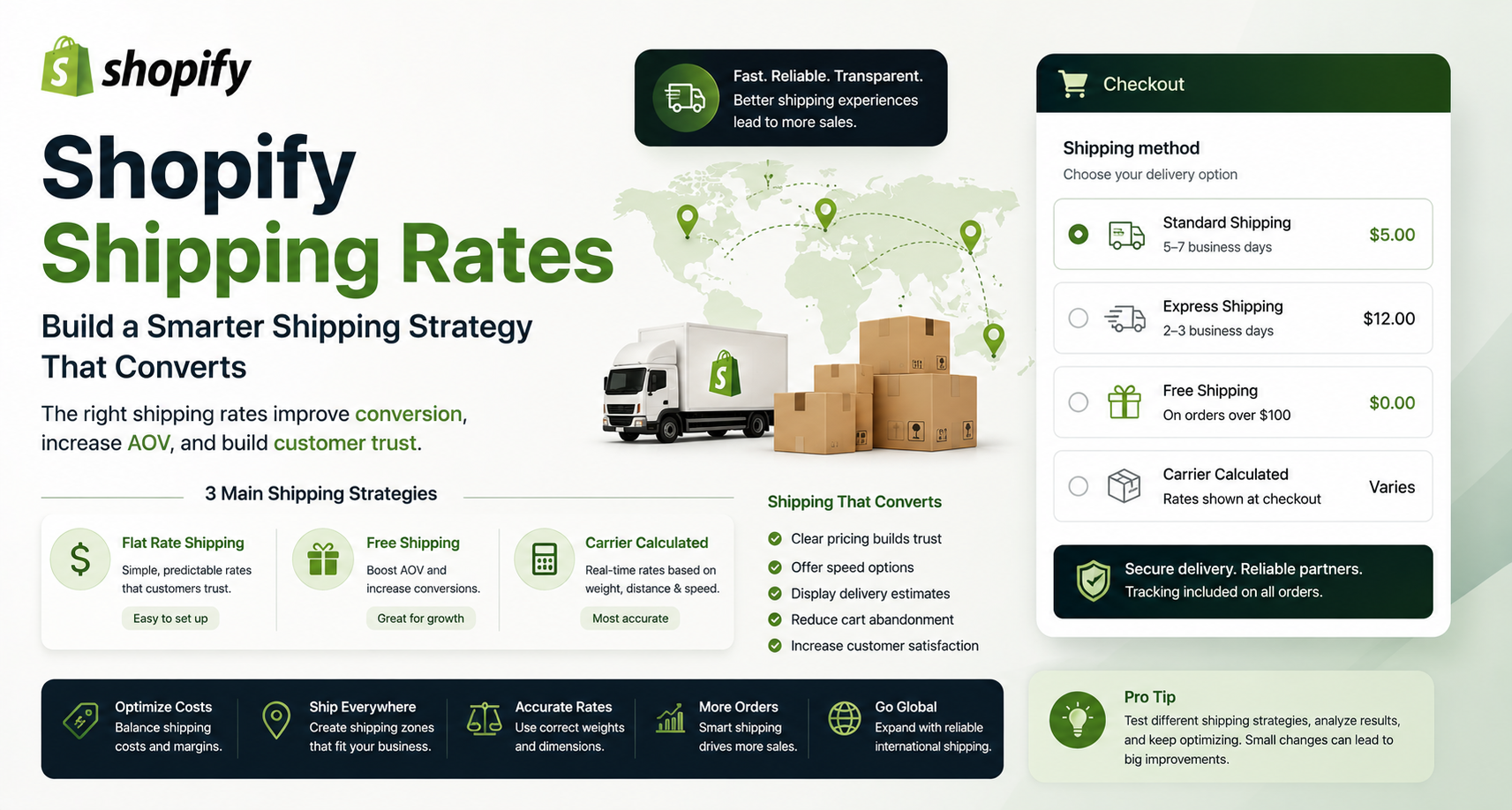
- Shipping rates are a critical conversion factor for eCommerce stores
- Shopify supports flat rates, free shipping, and carrier-calculated rates
- Free shipping thresholds can significantly increase average order value
- A/B testing different shipping strategies helps optimize conversions
Shipping is one of the last things customers see before they click Buy.
And it can be the reason they don't.
A product can have the perfect price, a beautiful Shopify store, and excellent reviews - but an unexpected $25 shipping charge at checkout can instantly change the customer's mind.
That makes Shopify shipping rates more than an operational setting. They're a conversion strategy.
What Are Shopify Shipping Rates?
Shopify shipping rates determine how much customers pay for delivery at checkout.
Merchants can configure rates based on factors such as:
- Order value
- Product weight
- Destination
- Delivery speed
- Shipping carrier
- Product-specific requirements
Shopify supports flat rates, free shipping, and carrier- or app-calculated rates. Shipping profiles allow merchants to create different shipping rules for specific products and locations.
The goal isn't simply to calculate postage. It's to find the right balance between customer expectations and business profitability.
The 3 Main Shopify Shipping Strategies
1. Flat Rate Shipping
Flat rate shipping is simple. You decide what customers pay.
For example:
- Standard Shipping - $5
- Express Shipping - $12
- Orders over $75 - Free Shipping
Shopify supports flat rates based on a fixed amount, order value, or weight.
This approach works particularly well for brands with predictable fulfilment costs.
The biggest advantage? Customers know what they're paying.
2. Free Shipping
"Free shipping" is one of the strongest offers in eCommerce.
But remember: shipping is never actually free. Someone pays for it.
The merchant can absorb the cost, increase product prices, or use a combination of both.
Shopify allows merchants to offer free shipping universally or conditionally - for example, when an order reaches a minimum value.
A simple strategy might be:
- $0 shipping on orders over $100
This can turn shipping into an average order value (AOV) strategy rather than simply a cost.
3. Carrier-Calculated Shipping
For businesses with variable shipping costs, carrier-calculated rates can be more accurate.
Shipping carriers calculate rates using information such as:
- Origin
- Destination
- Package weight
- Package dimensions
- Shipment value
- Delivery speed
Shopify supports carrier-calculated rates through carriers, shipping apps, and eligible third-party carrier accounts.
The advantage is accuracy. The disadvantage? Customers may only discover the final shipping cost at checkout, which can create unexpected costs and potentially contribute to checkout abandonment.
Shipping Profiles: The Feature Many Merchants Underuse
Not every product should have the same shipping rules.
Imagine a Shopify store selling:
- T-shirts
- Shoes
- Furniture
- Fragile products
Using one shipping strategy for everything could destroy your margins.
That's where shipping profiles become useful. You can create different shipping rules for specific products and fulfilment locations.
For example:
- Standard Products - $5 shipping
- Heavy Products - Carrier-calculated shipping
- Premium Products - Free shipping
This gives merchants much more control.
The Biggest Shopify Shipping Mistake
Many merchants calculate shipping from the carrier's perspective. Customers don't think that way.
They think:
"How much will I pay, and when will I receive it?"
That's why shipping strategy should consider both cost and customer experience. A good shipping option communicates: Price + Speed + Confidence.
For example, "Express Delivery - $14.99 - Arrives in 1–2 business days" is much more useful than simply "Express - $14.99".
Shopify supports transit-time information for shipping options, including flat rates, helping merchants communicate delivery expectations at checkout.
A Better Shopify Shipping Framework
Before setting your rates, calculate five numbers:
- Average Shipping Cost — What's the average amount you actually spend to deliver an order?
- Average Order Value — How much does the typical customer spend?
- Gross Margin — How much room do you have to absorb shipping costs?
- Customer Expectations — Do customers expect economy, standard, or next-day delivery?
- Geographic Distribution — Where are your customers located?
Once you know these numbers, build your shipping strategy around them.
What Developers Should Know
Shipping isn't only an Admin configuration problem.
For advanced Shopify implementations, developers can customise how delivery options appear at checkout using Shopify Functions.
The Delivery Customisation Function API can:
- Hide delivery options
- Reorder delivery options
- Rename delivery options
- Add messaging to delivery options
For example, a merchant could prioritise a preferred shipping method or hide a delivery option for certain scenarios. Shopify currently allows up to 25 active delivery customisation functions per store.
This opens the door to much more intelligent shipping experiences.
What Most Shopify Stores Get Wrong
- Offering Too Many Options — More choices don't always mean better UX. Give customers clear options.
- Using Free Shipping Without Doing the Math — Free shipping can improve conversion, but the cost still needs to be recovered somewhere.
- Ignoring Product Weight — Incorrect product weights can produce inaccurate carrier-calculated rates.
- Creating Shipping Gaps — If weight- or price-based tiers don't cover the full range of possible orders, Shopify can fail to return an applicable rate at checkout.
- Forgetting International Shipping — Different markets have different delivery expectations, costs, taxes, and duties. Don't treat global shipping as simply "domestic shipping × more countries."
The Future of Shopify Shipping
Shipping is becoming increasingly intelligent.
The next generation of Shopify stores will combine:
- Real-time carrier rates
- Predictive delivery estimates
- Smart shipping recommendations
- Automated fulfillment decisions
- Personalised delivery options
The objective isn't simply to charge the right amount. It's to show the right delivery option to the right customer at the right moment. That's where shipping becomes a competitive advantage.
Key Takeaways
- Shopify supports flat, free, and carrier-calculated shipping rates.
- Shipping profiles help merchants create product-specific strategies.
- Free shipping can be used to encourage higher order values.
- Accurate product weights and dimensions are critical for calculated rates.
- Delivery time is as important as delivery price.
- Shopify Functions can customise delivery options at checkout.
- The best shipping strategy balances conversion, customer experience, and margin.
Final Thoughts
Shipping is often treated as a technical configuration. It shouldn't be. It's part of your sales experience.
A customer who sees a clear price, realistic delivery time, and trustworthy shipping option is more likely to complete the purchase.
So before you simply enter a shipping rate into Shopify, ask a better question:
What shipping experience will make my customer feel confident enough to click "Buy Now"?
Because the best Shopify shipping strategy doesn't just move products. It moves customers toward conversion.