- Website costs range from $2,500 for basic sites to $170,000+ for enterprise platforms
- Scope, functionality, and integrations are the primary cost drivers
- Always factor in ongoing maintenance, hosting, and future updates
- Choose a vendor model that aligns with your budget and timeline
A website can cost a few thousand dollars. Or it can cost hundreds of thousands. So why do two businesses receive completely different website development quotes?
The answer isn't simply the number of pages. A five-page website with complex integrations can cost more than a 50-page informational site. An enterprise platform with custom workflows, security requirements, APIs, and AI capabilities can require a completely different budget from a small business website.
In 2026, website development cost is primarily driven by scope, functionality, technology, development expertise, location, integrations, security, and long-term maintenance.
This guide explains what businesses should consider before setting a website development budget.
How Much Does It Cost to Build a Website in 2026?
There is no single price for website development.
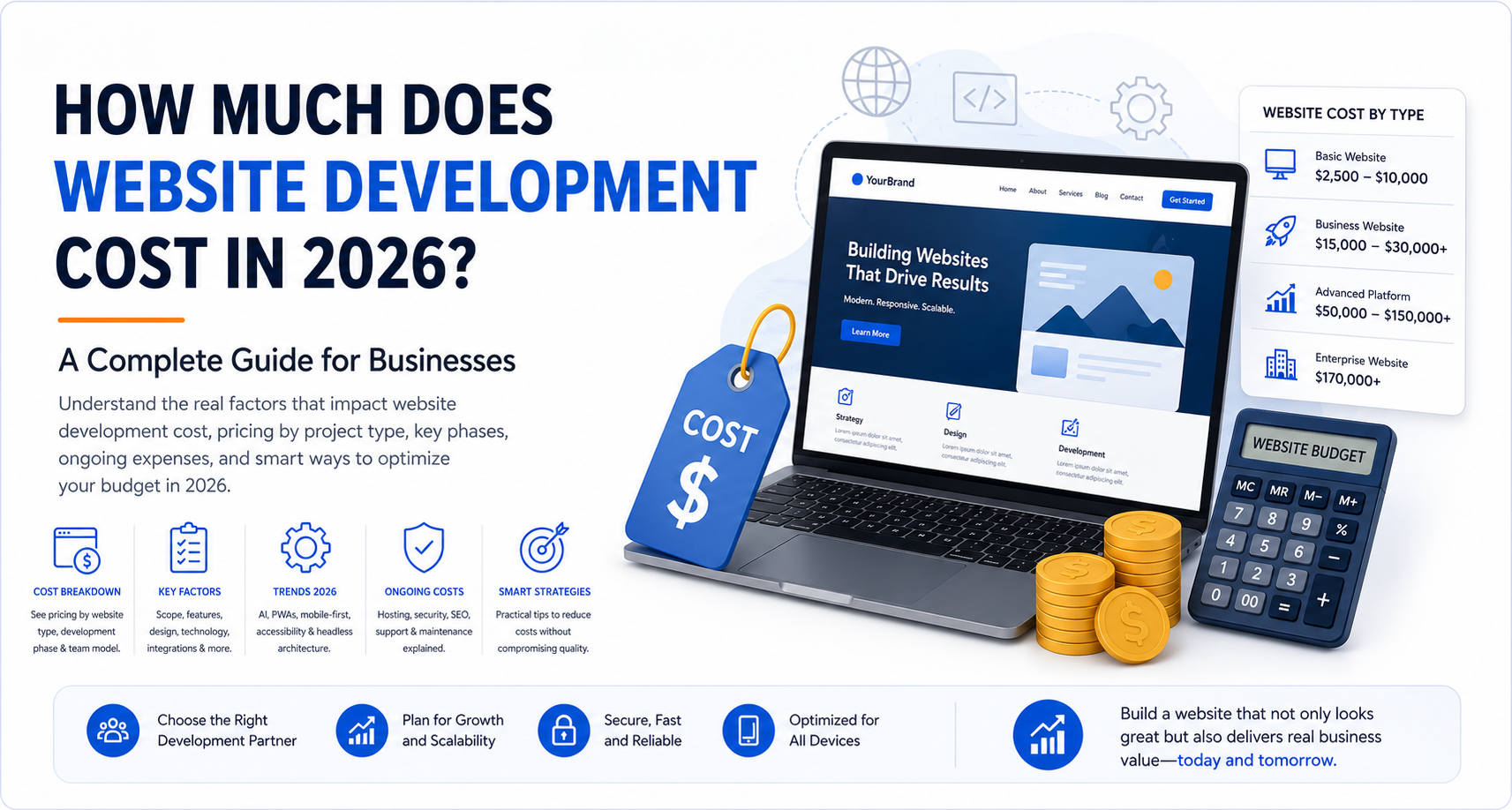
A simple small-business website may cost approximately $2,500–$10,000, while many custom business websites fall into the $15,000–$30,000 range.
More sophisticated enterprise websites can start around $170,000 and increase substantially depending on requirements.
A useful way to think about the market is:
| Website Type | Approximate Development Cost |
|---|---|
| Basic business website | $2,500–$10,000 |
| Professional custom website | $15,000–$30,000+ |
| Advanced custom platform | $50,000–$150,000+ |
| Enterprise website/platform | $170,000+ |
These are planning ranges, not fixed prices.
The final number depends on what the website needs to accomplish.
The Biggest Factors That Determine Website Development Cost
1. Project Scope
Scope is usually the biggest cost driver.
A website that only presents information is relatively straightforward.
A website that allows users to register, purchase products, upload documents, communicate with employees, manage subscriptions, or connect with external systems requires significantly more engineering.
Before requesting a quote, define:
- What should users be able to do?
- Who will use the website?
- What business processes should it support?
- Which systems need to connect to it?
- What must be available at launch?
- What can be added later?
A clear scope produces a much more reliable estimate.
2. Website Size
The number of pages still matters, but it shouldn't be your primary budgeting metric.
Consider two websites:
Website A: 40 informational pages using a common CMS structure.
Website B: 10 pages containing customized dashboards, payment processing, account management, APIs, and complex business logic.
Website B could easily require more development effort.
Size affects content, storage, navigation, templates, and testing—but functionality generally matters more than page count.
3. Design and UX
A professional website requires more than attractive colors and images.
Depending on the project, the design process can include:
- User research
- Information architecture
- Wireframes
- User journeys
- UI design
- Design systems
- Responsive layouts
- Accessibility
- Prototyping
- Usability testing
A simple marketing website may require a relatively small design effort.
A complex SaaS platform or enterprise portal can require dozens of user flows and screens.
That difference directly affects cost.
Website Development Cost by Development Phase
Breaking the project into phases makes the budget easier to understand.
UI/UX Design
Typical projects can require 1–2 weeks for design, while costs can range widely depending on the number of screens, user journeys, research, and complexity. Current industry estimates range from approximately $1,500 to $80,000.
Front-End Development
Front-end development turns designs into an interactive experience. It may include:
- HTML/CSS
- JavaScript
- React
- Angular
- Responsive layouts
- Animations
- Accessibility
- API integration
Typical timelines can range from 2–6 weeks, with costs around $3,500–$50,000, depending on complexity.
Back-End Development
The back end handles the logic behind the website. It may include:
- Databases
- Authentication
- APIs
- Payments
- Business rules
- Integrations
- User permissions
- Data processing
Projects can take 3–8 weeks or longer, with indicative costs ranging from approximately $5,000–$40,000 for many projects.
CMS or Admin Panel
A content management system allows teams to manage website content without changing code. Costs depend on whether you're:
- Configuring an existing CMS
- Customizing WordPress
- Building a headless CMS
- Developing a completely custom administration platform
Indicative development costs can range from approximately $3,000–$50,000.
Quality Assurance
Testing shouldn't be an afterthought. A professional QA process may include:
- Functional testing
- Browser testing
- Mobile testing
- Performance testing
- Security testing
- Usability testing
- Regression testing
Smaller projects may spend around $1,000–$5,000 on QA, while large enterprise projects can require significantly more.
Technology Choices Can Change the Budget
Your technology stack affects both development and long-term ownership.
A relatively simple website might use:
- WordPress
- Shopify
- Webflow
- Wix
- Squarespace
A more sophisticated application might require:
- React
- Angular
- Node.js
- Python
- Java
- .NET
- PostgreSQL
- MongoDB
- AWS
- Azure
- Google Cloud
There is no universally "best" stack. The right choice depends on performance requirements, scalability, integrations, developer availability, security, and future roadmap.
Custom Features Can Quickly Increase the Budget
Custom functionality is where many website budgets expand. Examples include:
E-commerce
- Product catalogs
- Shopping carts
- Payment gateways
- Discounts
- Inventory
- Shipping
- Tax calculations
- Customer accounts
Customer Portals
- Login
- Profiles
- Documents
- Subscriptions
- Orders
- Notifications
Enterprise Integrations
- CRM
- ERP
- Payment systems
- Accounting software
- Marketing platforms
- Internal databases
- Third-party APIs
AI Features
Modern websites increasingly incorporate:
- AI chatbots
- Recommendation engines
- AI search
- Content generation
- Document analysis
- AI agents
- Personalized experiences
AI can increase initial development costs, and AI-powered features may also create ongoing API or infrastructure expenses.
Website Development Cost Also Depends on Location
Two companies can quote very different prices for essentially the same requirements. Why? Developer rates vary significantly by region.
But price shouldn't be the only consideration. Evaluate:
- Technical expertise
- Communication
- Time-zone overlap
- Project management
- Quality assurance
- Security practices
- Portfolio
- Support
- Long-term availability
The cheapest quote isn't necessarily the cheapest project. A low-quality implementation can create expensive technical debt later.
Agency vs. In-House vs. Freelancer vs. DIY
One of the biggest decisions businesses make is who should build the website.
Hiring a Development Agency
An agency generally provides access to multiple specialists:
- Developers
- Designers
- QA engineers
- Project managers
- Architects
- SEO/content specialists
Custom agency-built websites commonly range from approximately $20,000 to $200,000+, depending on complexity, with many projects delivered over several weeks or months.
This option makes sense when quality, scalability, deadlines, and accountability are important.
Building an In-House Team
An internal team gives the business direct control. But the real cost includes much more than salaries:
- Recruitment
- Benefits
- Payroll
- Management
- Equipment
- Training
- Software
- Office costs
- Employee retention
In-house development can make sense when the website is a core part of the company's product or operations.
Hiring Freelancers
Freelancers can be an excellent choice for smaller projects. Current indicative rates show web developers commonly ranging around $15–$50/hour, with professional freelance website projects often starting around $2,500–$5,000 and larger custom projects potentially reaching $30,000–$50,000+.
Businesses should carefully evaluate:
- Portfolio
- Communication
- Availability
- Technical depth
- Code ownership
- Security
- Post-launch support
Building the Website Yourself
DIY website development can be appropriate for:
- Personal websites
- Small portfolios
- Basic landing pages
- Early-stage experiments
Website builders and hosting can typically range from roughly $20–$300 per month, depending on the platform and features.
For a business-critical website, professional development may provide better long-term value.
Don't Forget Website Maintenance Costs
Launching your website isn't the end of the budget. It's the beginning of ownership.
Hosting and Domain
A standard domain can cost roughly $10–$20 annually, while hosting varies according to traffic and infrastructure.
Security
Regular security updates, backups, monitoring, audits, and malware protection are essential. Security maintenance may cost approximately $20–$100 per month for certain services.
Content and SEO
Businesses may spend approximately $500–$2,500+ per month on outsourced SEO and content marketing, depending on their objectives and scale.
Technical Support
Freelance technical support can range from approximately $50–$150/hour, with senior specialists potentially charging more. Agency retainers may start around several hundred dollars per month.
Website Development Trends Affecting Cost in 2026
Mobile-First Development
More than half of global web traffic now comes from mobile devices, making mobile-first design a fundamental requirement rather than an optional enhancement.
Progressive Web Apps
PWAs can bring app-like capabilities to websites, including offline functionality and notifications. They can be attractive when businesses want advanced experiences without maintaining separate native applications.
AI and Intelligent Search
AI-powered chatbots, semantic search, recommendations, and AI agents are becoming increasingly common. These features can improve user experience but introduce development, testing, infrastructure, and API costs.
Accessibility
Accessibility is becoming increasingly important both commercially and legally. Designing accessibility into a website from the beginning is generally more efficient than rebuilding an inaccessible site later.
Headless Architecture
Headless architecture separates the front end from the content and commerce back end. This can make it easier to deliver content across websites, mobile applications, kiosks, digital displays, and other customer interfaces—but it also introduces additional development complexity.
How to Reduce Website Development Costs Without Destroying Quality
A smaller budget doesn't automatically mean a low-quality website. The key is prioritization.
1. Define Your MVP
Separate must-have features from nice-to-have features. Launch the features that create immediate business value first.
2. Reuse Proven Technology
Don't build everything from scratch. Use established frameworks, CMS platforms, APIs, payment providers, authentication systems, and open-source libraries. Custom code should be reserved for areas where it creates real differentiation.
3. Use Agile Development
Break the project into manageable stages. Instead of waiting months to see the final product, businesses can review progress continuously and adjust priorities as they learn.
4. Consider Outsourcing
For short-term projects, outsourcing can be more economical than recruiting an entire internal development team.
5. Budget for the Future
Don't spend your entire budget on launch. Reserve funds for security, hosting, updates, SEO, performance optimization, new features, and technical support.
A website should be treated as a long-term digital asset.
How to Choose the Right Web Development Partner
Before selecting a development company, look beyond the proposal price. Ask these questions:
Do They Have Relevant Experience?
Look for projects similar to yours.
Can They Show Real Case Studies?
A strong portfolio should demonstrate both visual quality and technical capability.
What Do Independent Reviews Say?
Check independent platforms rather than relying entirely on testimonials published by the vendor.
Are They Transparent?
The proposal should clearly explain scope, deliverables, timeline, technology, assumptions, payment structure, and support.
Who Owns the Code?
Make sure ownership and intellectual property rights are clearly documented.
What Happens After Launch?
Ask about warranty, maintenance, security, monitoring, support response times, and future development.
The cheapest proposal can become the most expensive decision if it creates delays, technical debt, or a complete rebuild.
A Practical Website Budget Framework
Before approaching a development company, prepare this checklist:
- Business objective: What should the website achieve?
- Target users: Who will use it?
- Core features: What must users be able to do?
- Integrations: Which external systems are required?
- Design: Template, customized, or completely bespoke?
- Technology: CMS, eCommerce platform, or custom application?
- Security: What data will be stored?
- Scalability: How much traffic do you expect?
- Timeline: When must the website launch?
- Post-launch: Who will maintain it?
Once these questions are answered, obtaining realistic quotes becomes much easier.
Frequently Asked Questions
Can I build a website without a developer?
Yes. No-code and low-code platforms make basic websites accessible to non-technical users. However, businesses with complex functionality, integrations, security requirements, or scalability needs generally benefit from professional development.
What is the average website development cost?
There is no universal average. A basic business website may fall around $2,500–$10,000, while many professional custom websites cost $15,000–$30,000+. Enterprise projects can begin around $170,000 and increase based on requirements.
How much should I budget for maintenance?
A useful planning benchmark is to reserve roughly 15–20% of the initial development cost annually, although actual maintenance costs vary significantly by website type and service requirements.
How long does website development take?
A simple business website may take approximately 4–8 weeks. More sophisticated platforms can take several months, depending on design, integrations, testing, and functionality.
Does the country of the development team affect cost?
Yes. Developer rates vary considerably by geography, experience, and specialization. But businesses should compare total value, not simply hourly rates.
Final Thoughts: Don't Ask Only "How Much?"
The better question is:
"What should this website accomplish for the business?"
Once the business objective is clear, the technology, features, development approach, and budget become much easier to determine.
A website isn't simply a collection of pages. It's a business system.
And the best investment isn't necessarily the website with the lowest development cost. It's the one that delivers the right experience, supports business growth, remains secure and maintainable, and creates measurable value over time.
Define the problem first. Prioritize the features. Choose the right technology. Build for today—but budget for tomorrow.